
 English grammar
Singular and plural nouns 📕
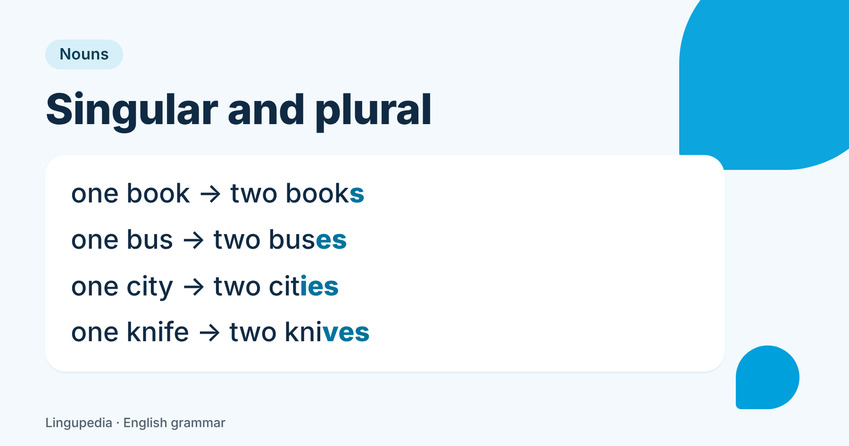
A noun is a word for a person, a thing, an animal or an idea: teacher, car, dog, love.
Most nouns have two forms: singular (one) and plural (two or more).
The main rule: add -s
| Singular | Plural |
| one book | two books |
| one car | three cars |
| a student | many students |
Add -es after s, ss, sh, ch, x and z
| Singular | Plural |
| bus | buses |
| class | classes |
| dish | dishes |
| watch | watches |
| box | boxes |
We add -es because it is easier to say. The ending sounds like an extra syllable: bus-es, watch-es.
Consonant + y: change y to -ies
| Singular | Plural |
| city | cities |
| baby | babies |
| country | countries |
If there is a vowel (a, e, o, u) before the y, just add -s: day → days, boy → boys, key → keys.
Words that end in -f or -fe
Many of these words change f to -ves:
| Singular | Plural |
| knife | knives |
| wife | wives |
| leaf | leaves |
| half | halves |
Some words only add -s: roof → roofs, chef → chefs.
Words that end in -o
Some add -es, some add -s:
- potato → potatoes, tomato → tomatoes, hero → heroes
- photo → photos, piano → pianos, radio → radios
Common mistakes
✗ I have two child.
✓ I have two children.
✗ She bought three tomatos.
✓ She bought three tomatoes.
💡 Some nouns are irregular. See the article "Irregular plurals".