
 English grammar
Punctuation: full stop, comma and question mark 📕
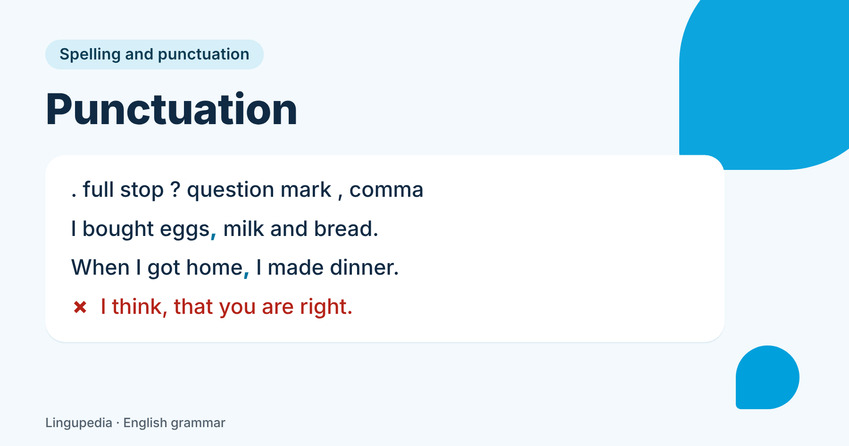
Full stop (.)
At the end of a normal sentence.
I live in Bodø.
Question mark (?)
At the end of a direct question.
Where do you live?
Not after an indirect question: She asked where I lived.
Exclamation mark (!)
For strong feelings, surprise or orders. Do not use it too often in formal writing.
Watch out!
Comma (,)
| Use | Example |
| Lists | I bought eggs, milk and bread. |
| After an introduction | However, it was too late. |
| Before but and so (two sentences) | I called, but she didn't answer. |
| After a clause with if, when, because at the start | When I got home, I made dinner. |
| Extra information | My brother, who lives in Oslo, is a nurse. |
| Before and after direct speech | She said, "Hello." |
No comma before that
✗ I think, that you are right.
✓ I think that you are right.
Numbers
English uses a full stop for decimals and a comma for thousands:
3.5 (three point five)
10,000 (ten thousand)