
 English grammar
Relative clauses: who, which, that 📕
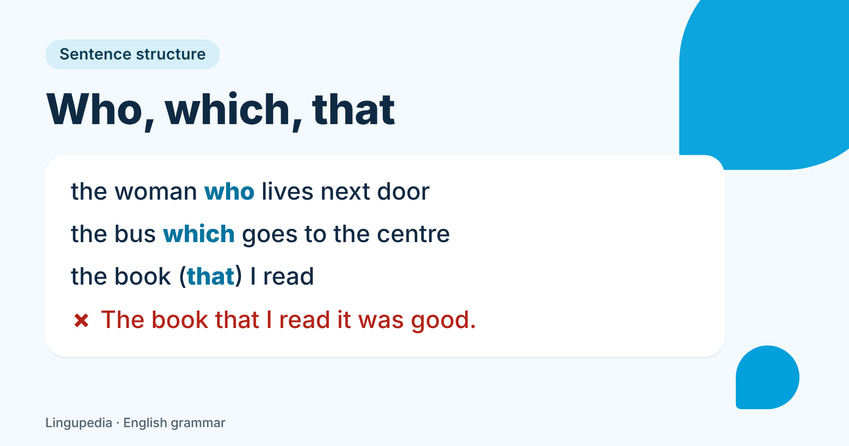
A relative clause gives more information about a noun. It starts with who, which, that, whose or where.
| Word | Used for | Example |
| who | people | The woman who lives next door is a nurse. |
| which | things, animals | The bus which goes to the centre is late. |
| that | people and things | The book that I read was good. |
| whose | owner | The man whose car was stolen called the police. |
| where | place | This is the town where I was born. |
Can we drop the word?
If the relative word is the object, we can drop it in everyday English:
The book (that) I read was good.
The man (who) I met was friendly.
If it is the subject, we cannot drop it:
✓ The woman who lives next door is a nurse.
✗ The woman lives next door is a nurse.
Do not repeat the pronoun
✗ The book that I read it was good.
✓ The book that I read was good.
Commas: extra information
Use commas if the information is extra, and the sentence makes sense without it. Do not use that here.
My brother, who lives in Oslo, is a doctor.