
 English grammar
Personal pronouns 📕
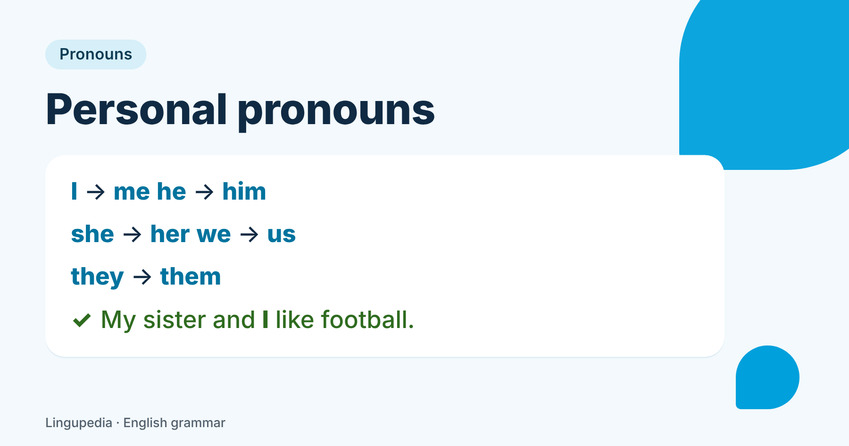
Pronouns replace a noun, so we do not have to repeat it. English has two forms: one for the subject and one for the object.
| Subject | Object |
| I | me |
| you | you |
| he | him |
| she | her |
| it | it |
| we | us |
| you | you |
| they | them |
Subject: before the verb
The subject is the person or thing that does the action.
She works in a shop.
We live in Drammen.
Object: after the verb or a preposition
Can you help me?
I called him yesterday.
This present is for them.
Always a capital I
I is always written with a capital letter, even in the middle of a sentence.
Yesterday I went to the cinema.
They for one person
We can use they about one person when we do not know if the person is a man or a woman, or when the person prefers it.
Someone called. They left a message.
It in English
It is used for things and animals. We do not use he or she about things.
✗ I bought a new table. He is big.
✓ I bought a new table. It is big.
✗ Me and my sister like football.
✓ My sister and I like football.