
 English grammar
Modal verbs: an overview 📕
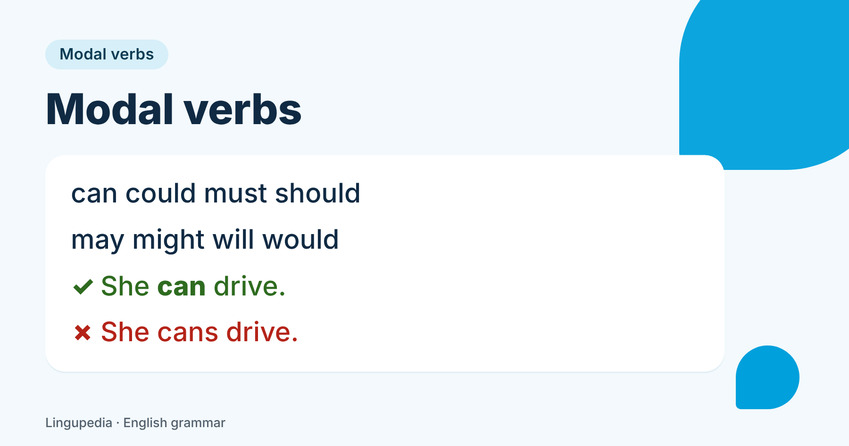
Modal verbs are small helping verbs. They show ability, permission, obligation, advice or possibility.
The modal verbs
| Modal | Main meaning | Example |
| can | ability, permission | I can swim. |
| could | past ability, polite request | Could you help me? |
| must | strong obligation | You must wear a seatbelt. |
| should | advice | You should see a doctor. |
| may | permission (formal), possibility | May I come in? |
| might | possibility | It might rain. |
| will | future, promise | I will call you. |
| would | polite wishes, hypothetical | I would like a tea. |
Three rules for all modal verbs
1. No -s with he, she, it
✓ She can drive.
✗ She cans drive.
2. The next verb is in the base form, without to
✓ I must go.
✗ I must to go.
✗ I must going.
3. No do / does in questions and negatives
✓ Can you swim?
✗ Do you can swim?
✓ I can't swim.
✗ I don't can swim.
Negative forms
can't (cannot), couldn't, mustn't, shouldn't, won't (will not), wouldn't