The difference between American and British English: a beginner’s guide
As English language learners embarking on the exciting journey of mastering this global language, it’s crucial to understand the delightful nuances that distinguish British and American English. In this article, we’ll explore some key differences between American and British English at an elementary level, touching upon vocabulary, spelling, pronunciation, and expressions. Additionally, we’ll highlight how

As English language learners embarking on the exciting journey of mastering this global language, it's crucial to understand the delightful nuances that distinguish British and American English. In this article, we'll explore some key differences between American and British English at an elementary level, touching upon vocabulary, spelling, pronunciation, and expressions. Additionally, we'll highlight how a specially created course can help you really understand both the linguistic but also cultural differences that both divide and unite these two great countries.
What are the main differences between American and British English?
Vocabulary:
One of the first things you'll notice is the diverse vocabulary used on either side of the Atlantic. For instance, in Britain, a "lorry" is a large vehicle used for transporting goods, while in America, it's simply called a "truck." Similarly, what Brits fondly refer to as "biscuits" are known as "cookies" across the pond in the United States. These differences may seem small, but they play a big role in understanding and communicating effectively in both English varieties.
American and British English spelling differences:
The spelling variations between British and American English are another intriguing aspect. Take the word "colour" in British English—it's perfectly correct. However, in American English, the spelling is simplified to "color." The same goes for "favourite" (British) and "favorite" (American), or "travelling" (British) and "traveling" (American). These spelling distinctions may appear in your reading, so you will know immediately where the writer comes from and of course you can decide which English you prefer to use!
British v American English pronunciation :
Pronunciation can be a delightful adventure in English. Consider the word "schedule." In British English, it's pronounced "shed-yool," while in American English, it's "sked-yool." Another example is the word "advertisement," where Brits say "ad-ver-tis-ment," while Americans often say "ad-ver-tize-ment." (different pronunciation and different stress) Becoming familiar with these pronunciation differences will not only make you sound more natural but also enhance your understanding of English speakers from both regions.

Expressions
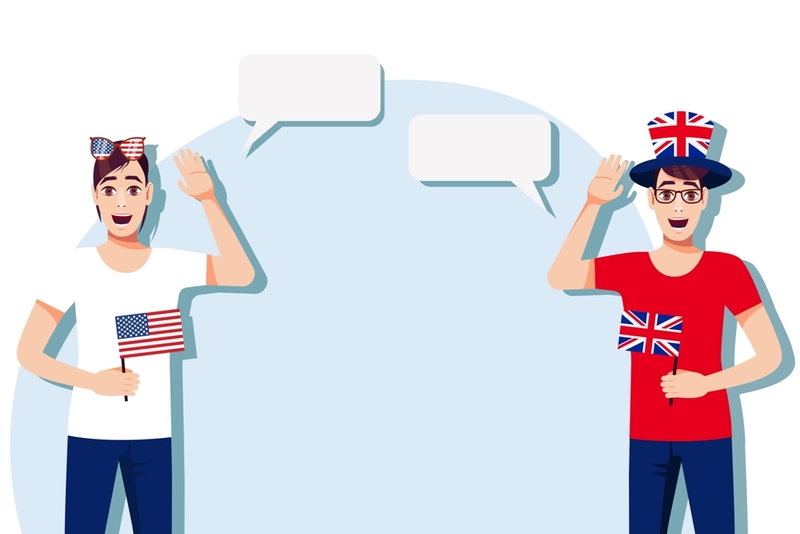
Using expressions, or idioms, will make you sound more natural when you speak English. For instance, if someone in Britain says, "I'm feeling peckish," they mean they're a bit hungry. On the other hand, an American might say, "Let's talk turkey" when they want to talk about business! Similarly, when a Brit says, "I'll give you a bell," it translates to "I'll call you" in American English. Understanding these expression will help you connect with native speakers on a deeper level.
American imports into British English
The reality is that American English today is more widely used than British English not least because of its size and use in all types of media ;especially films (or movies) and on the internet. So it's not surprising that there are many expressions and words used in British English that not that long ago were considered incomprehensible or even wrong. That's why today in British English we also say "I'm good" in addition to "I'm well" in answer to the question "How are you?", we say "Can I get…? " instead of "Can I have…?" (when asking for a coffee for example) And we now all "reach out' to each other instead of "contacting' or "asking".. "I'm reaching out to find out if you would like to come to the presentation"

Start improving your English skills today
Written by
David de Jager
Published Feb 26, 2024