Cambridge English preparation
Find the qualification that fits your goals, check your English level and get advice on what to study next.


The Cambridge English Qualifications are a suite of English language exams produced by Cambridge English, part of Cambridge University Press & Assessment — a non-teaching department of the University of Cambridge. The first Cambridge exam ran in 1913, which makes this the longest-running English-exam suite in the world.
One feature sets Cambridge apart from IELTS, TOEFL and most other proficiency tests: a Cambridge English certificate does not expire. You earn it once and keep it for life — though individual institutions may still ask for a recent result, so always check the requirements where you are applying.
First Cambridge English exam
The longest-running suite of English exams in the world.
Recognising institutions
Accepted by universities, employers and governments in more than 130 countries.
Never expires
Unlike IELTS and TOEFL, your Cambridge certificate is for life.
This is where Cambridge English shines. C1 Advanced is the most widely accepted Cambridge qualification for university entry — almost every UK university (Oxford, Cambridge, LSE included) and a large number of European, Australian and Canadian institutions accept it.
In Lithuania, Romania, Slovakia and Ukraine, C1 Advanced can also exempt you from the English component of national school-leaving exams.
Cambridge English is widely accepted by universities and most international employers as evidence of English proficiency. For visa applications the rules vary by country and route:
If in doubt, ask the institution or immigration authority which tests they accept before you book an exam.
Each Cambridge exam reports reliably on the level above and below the target — so a strong B2 First performance can earn a C1 certificate, and a weaker one still earns a B1. The exam is almost never wasted.
All five general qualifications test the same four skills: Reading, Writing, Listening and Speaking. From B2 upward, Use of English (grammar and vocabulary) is integrated into the Reading paper. Every exam is available on paper or on a computer, and the Speaking test is always face-to-face with examiners — taken in pairs (or groups of three), not alone.
| Qualification | CEFR | Approximate length | Papers |
|---|---|---|---|
| A2 Key | A2 | ~1 h 50 min | Reading & Writing · Listening · Speaking |
| B1 Preliminary | B1 | ~2 h 20 min | Reading · Writing · Listening · Speaking |
| B2 First | B2 | ~3 h 30 min | Reading & Use of English · Writing · Listening · Speaking |
| C1 Advanced | C1 | ~4 h | Reading & Use of English · Writing · Listening · Speaking |
| C2 Proficiency | C2 | ~4 h | Reading & Use of English · Writing · Listening · Speaking |
All five qualifications report on the Cambridge English Scale — a single 80–230 scale that covers every level from Pre-A1 to C2 — with a grade (A, B or C) and a CEFR-level certificate.
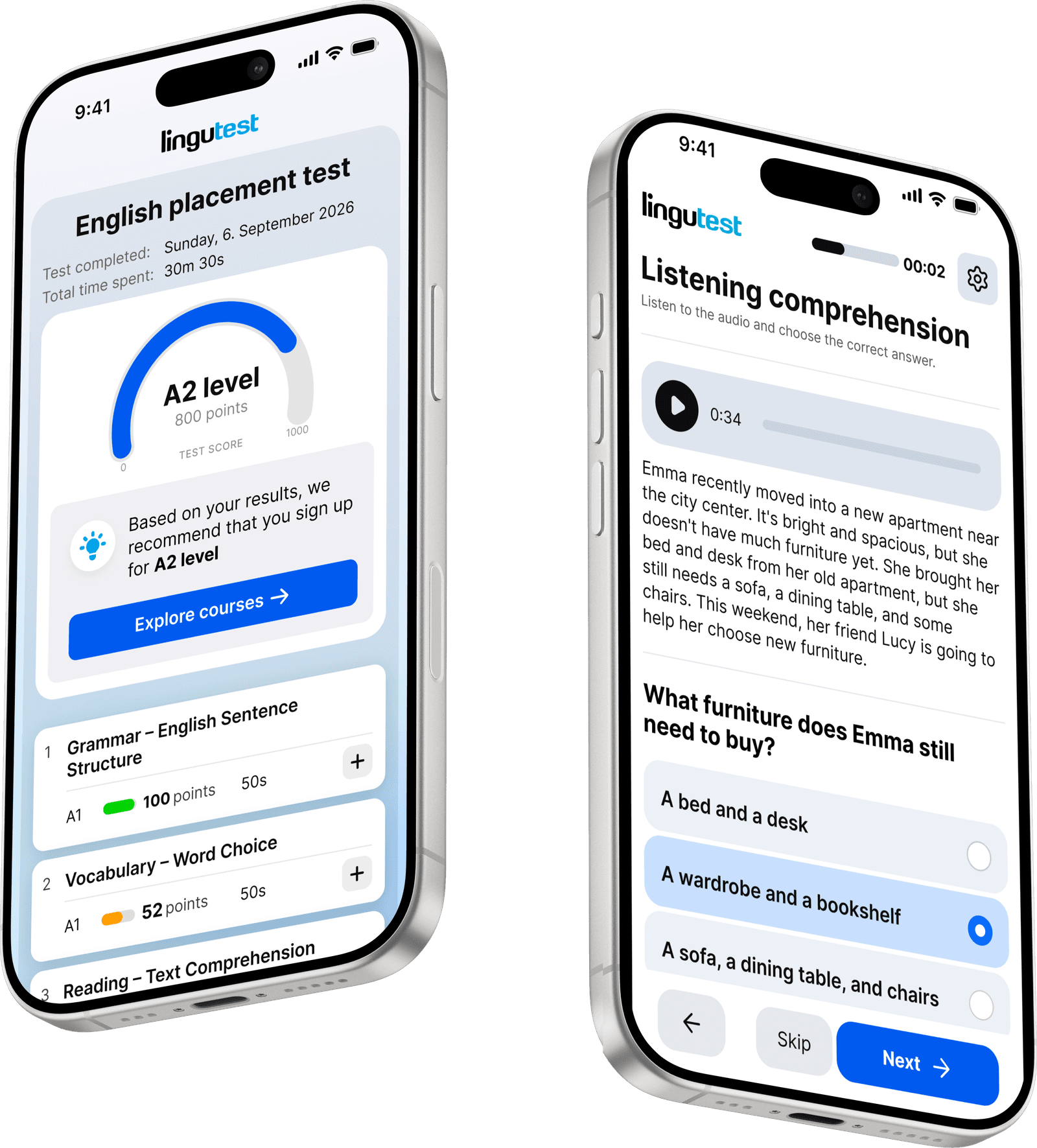
Take the free English placement test and start in the right place.